
The Rubber Duck That Talks Back
By Jake Moses
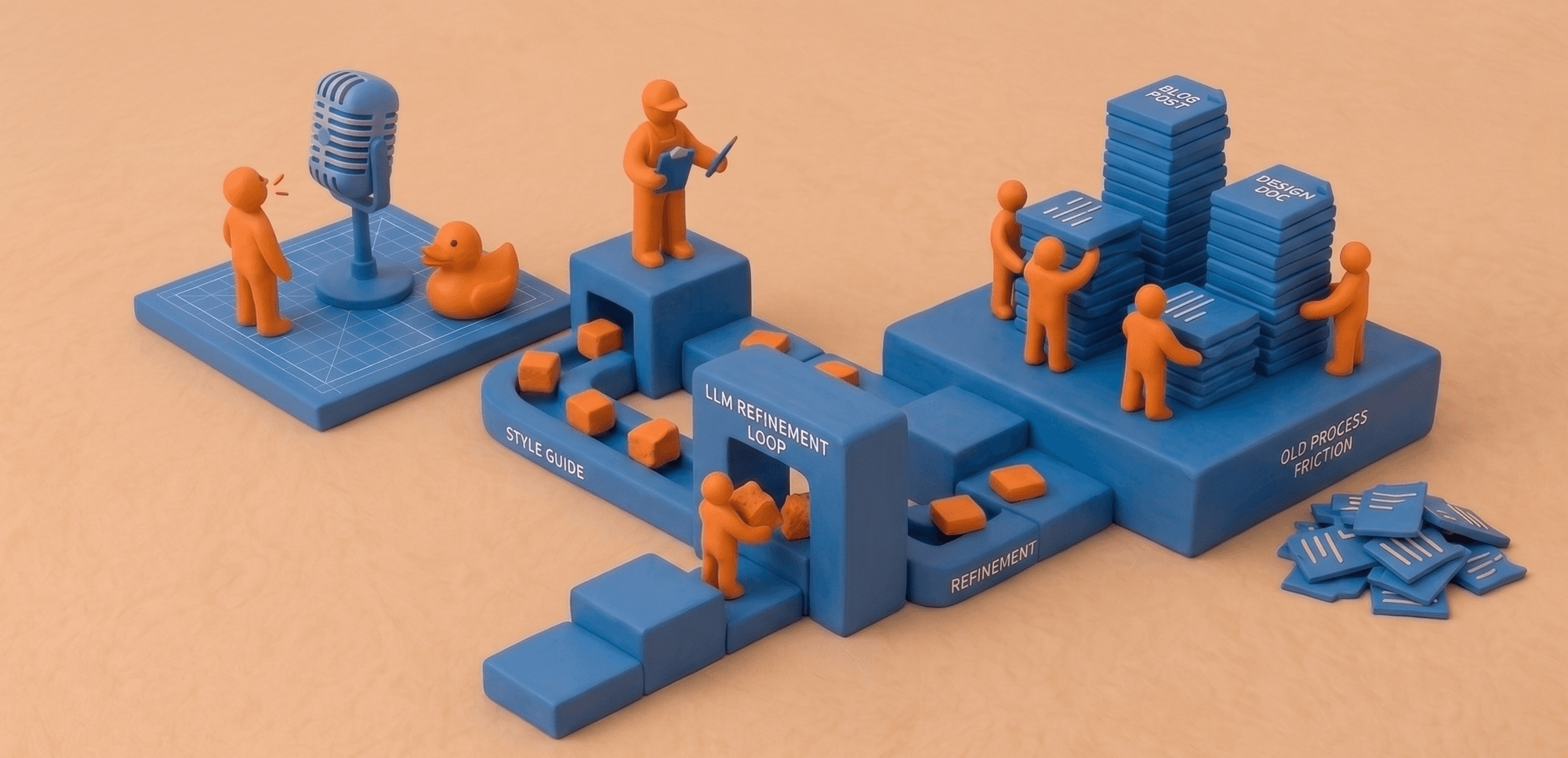
A professor of mine back at the University of Virginia taught me the rubber duck method: talk through your whole plan out loud to a rubber duck sitting in front of you, and listen for the places where the gaps show up. She meant it for debugging software, but over time it became how I think about almost anything. My real process for working through an idea is a chain: talk it out, challenge my own assumptions, note wherever I get stuck, then reshape all of it into something more cohesive.
Every step in that chain lost something. Ideas got flattened as I forced them onto the page. Others arrived half-formed, because the version alive in my head never survived the trip into written words. The talking was never the problem, and neither was the thinking. The problem was the distance between how I think and how I tried to express it through writing.
A Rubber Duck That Talks Back
LLMs changed the shape of this for me in two ways.
The obvious one is that my rubber ducky can respond now. Prompted well, a model will push back on my plan, flag a gap in the logic, and help me organize my thoughts in a more cohesive way.
The second one is quieter, and it's where I've gotten most of my mileage. I can speak an idea in my own stream of consciousness and hand it to a writing assistant that carves it into the shape it needs to take to help with easier digestion of the ideas, whether that's a blog post or a design doc. The thinking stays mine and the translation to written text is much less agonizing.
How the Workflow Runs
The version I've settled on is simple. I talk, on a long drive, on a walk, or in a booth at the office, and a transcription tool captures it. I use Superwhisper; Wispr Flow and a handful of others do the same job. Then Claude takes the raw transcript. Because it has context on my earlier writing, projects I have been working on, and how I have thought through ideas in the past, it already has a feel for my tone and the formats I reach for. I tell it what I'm making and who it's for, and it gets me about ninety percent of the way there. I read it a few times, swap some words, iterate, and that's the draft.
I'm not the only one who's drifted this way. Andrej Karpathy recently described his own version of it: flip on voice mode, talk through a project for about ten minutes without polishing anything, and tell the model up front that the input is going to be messy so it can focus on what you mean instead of how you said it. He put it as "completely messy and anything goes." The mess is the point. Getting the thought out is the hard part, and turning it into clean sentences is exactly what the model is good at.
I occasionally work with the live voice conversations as well. They're good when you need a thought partner, but I found that they tend to jump in with their own thoughts more than I want when I'm still trying to hear myself think.
The same loop runs at work, not just on these posts. My team and I can talk through an entire project, grounded in the actual code and in what we're trying to deliver for a customer, and come out the other side with a list of high level notes and action items. This then becomes routine to turn into Linear tasks (as I discuss in my previous blog post) or to send meeting summaries to stakeholders.
Whose Words Are These?
There's a fair objection buried in all of this. If the model writes the sentences, is the document or post still mine?
I went back and forth on it. A lot of the words on the page are technically the model's, after a few rounds of iteration. But the models are good enough now that the output doesn't read like the old tell-tale LLM slop, the giveaway phrasing you learn to spot (a stray hyphen or two may still sneak through). What lands on the page is my stream of consciousness: the ideas, the order I arrived at them, the way I'd actually say them out loud. That's the part I care about. My high school English teacher had me pegged as a B+ writer at my best, and I've made peace with that. This helps me communicate my ideas to others in a way that is hopefully closer to an A.
This is one of the things that's been the most fun to experiment with at Pedestal, as we fold LLMs and speech-to-text deeper into how we work. Dictation isn't new. What's new is that the tool on the other end finally understands you well enough that speaking your mind and writing it down have become the same act.